You Don't Have a Volume Problem. You Have a Repeat Failure Problem.
Most contact centers aren't handling demand. They're funding it.
Every capacity investment, every efficiency push, every automation layer added to manage volume. Most of it is paying to absorb failures the operation didn't create and can't see clearly enough to fix.
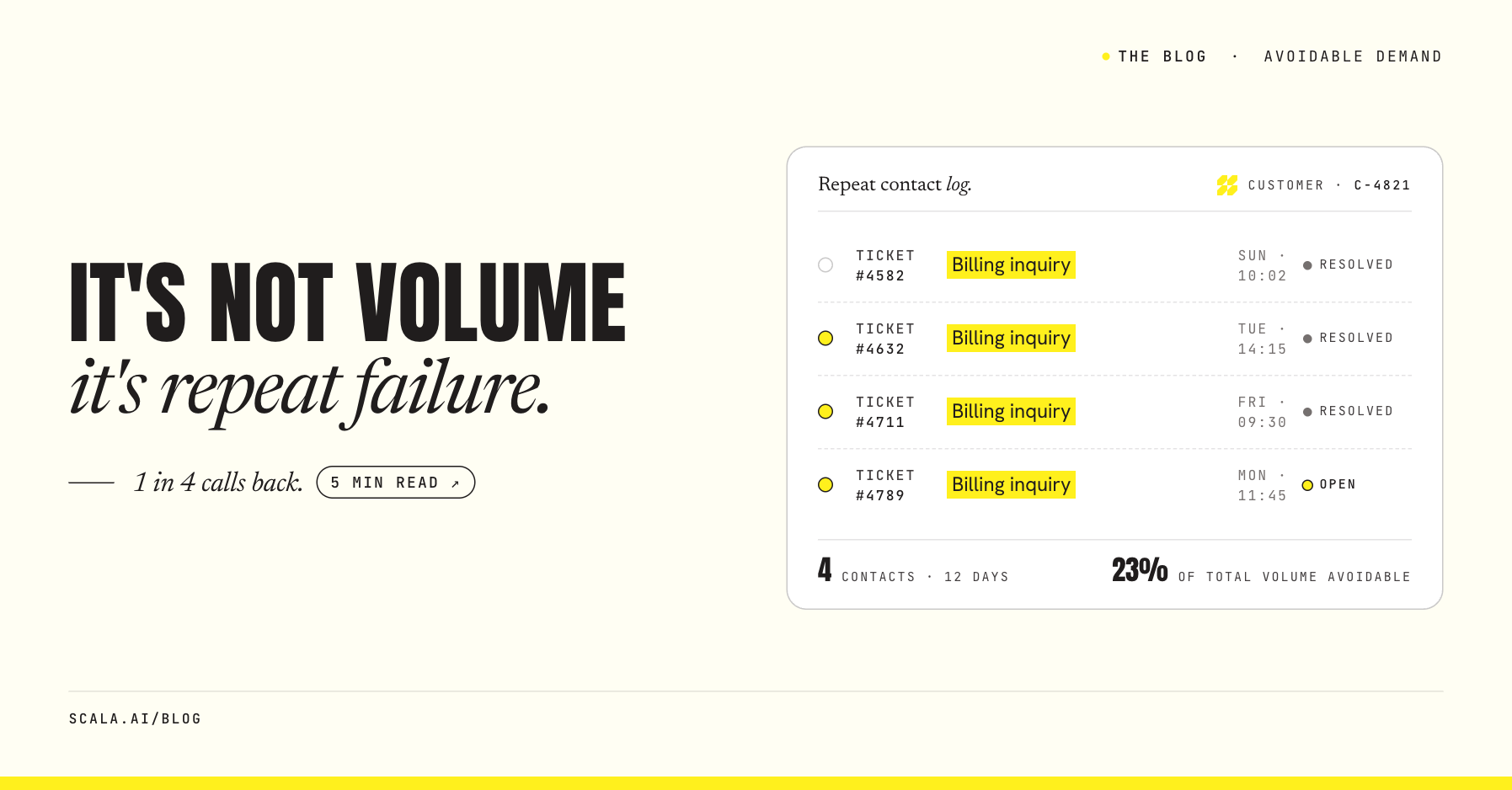
20 to 30% of contact center demand is avoidable. Not new demand. Repeat demand. A confusing bill becomes a call. A broken digital experience becomes three. A failed handoff sends the customer back to the start. It looks like volume. It's the same failure returning.
Industry data puts first contact resolution between 70 and 79%. That means one in four customer interactions requires a follow-up. Each one compounding cost. Each one eroding the experience a little further.
None of it starts in the contact center. It starts upstream. Billing. Product. Digital. Policy. The contact center absorbs the consequence. So leaders respond the only way the model allows: add capacity, optimize efficiency, introduce automation.
The volume stays. Because the source hasn't changed.
The contact center isn't broken. It's doing exactly what it was designed to do: catch what falls through everywhere else. The problem is that catching failures at the end is expensive. Fixing them there is impossible.
For years, leaders couldn't see far enough upstream to change this. Data was fragmented. Journeys were unclear. Causes were hard to prove. So teams adapted. They managed what they could see and absorbed what they couldn't.
That limitation is gone.
The question is no longer whether the data exists. It's whether leaders have a view that connects it. Where journeys break. Where context gets lost between systems. Why customers return after a resolution that didn't hold.
When that becomes visible, the job changes.
Leaders stop managing volume. They start removing the friction that creates it.
Scala connects signals across conversations, workflows, and systems to show where avoidable demand originates. Repeat failures surface before they compound. Causes become visible across the full journey, not just inside the contact center.
Most teams need a clearer view of what the system is already telling them.
Until that view exists, teams will keep funding problems that shouldn't exist.
Learn more with a Scala Demo
Latest Resources

Scala Partners with Zing Health to Advance Quality and Performance Intelligence Across Medicare Advantage Member Services
Scala partners with Zing Health to modernize Medicare Advantage member services through quality and performance intelligence, helping teams improve coaching, service consistency, and member experience.