The Blind Spot at the Center of Every QA Program
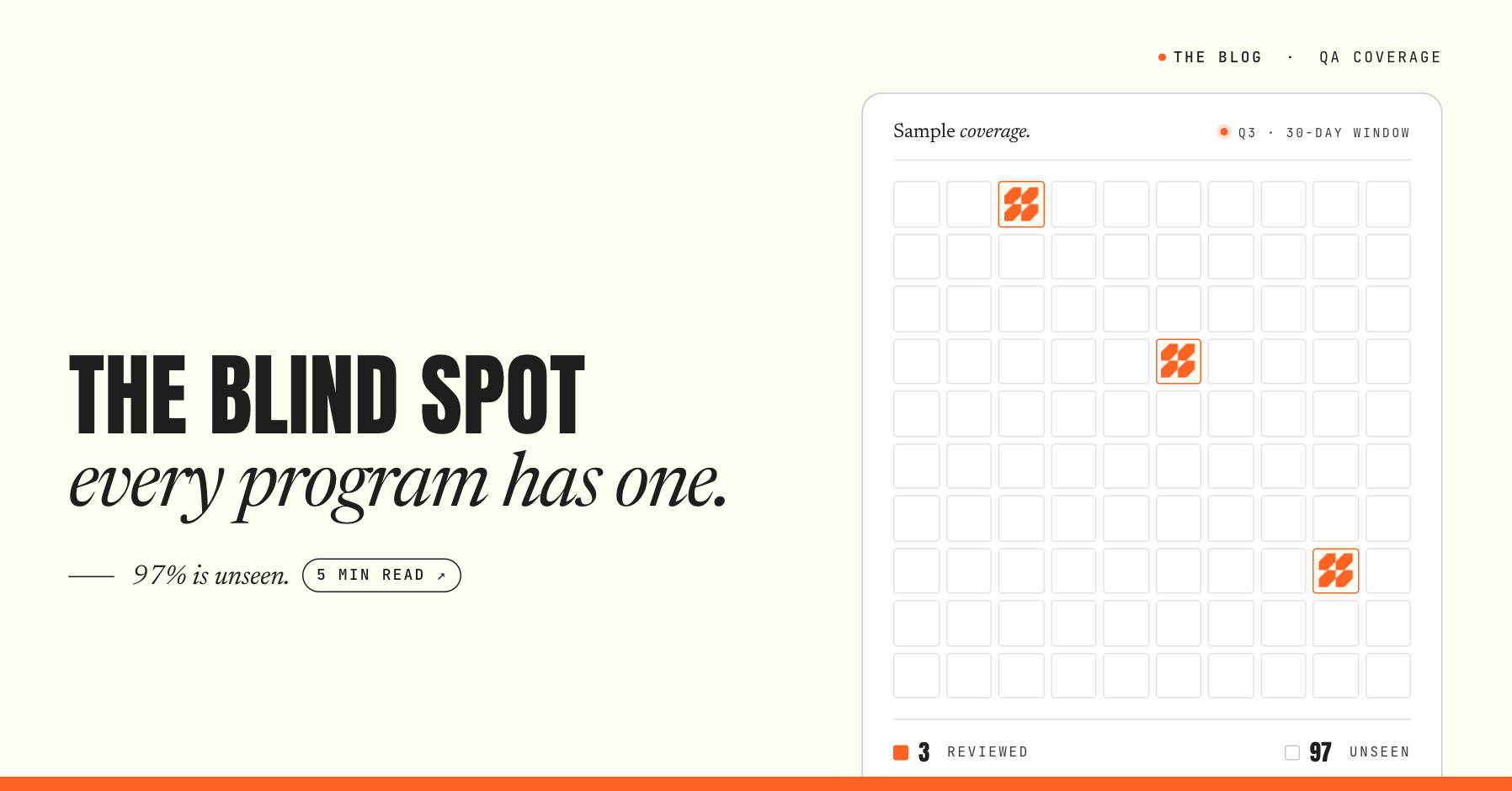
Most contact centers review less than 3% of customer interactions.
Every quality decision in the business is built on that number.
CX leaders know this. Few stop to ask what it actually costs them.
That 3% means 97% of customer conversations go completely unseen. Scorecards get built. Agents get coached. Standards get enforced. All from a sample so narrow it was never designed to represent how the operation actually behaves.
The result isn't quality management. It's the appearance of quality management.
The operation feels it. The same issues keep surfacing. Coaching doesn't move the numbers. A problem gets fixed, then returns. Leaders sense something is wrong but can't see clearly enough to find it.
That's what a 3% sample produces: confident decisions made from incomplete data.
The math is concrete. If an agent handles 1,000 calls a month, a statistically valid QA sample requires around 278 reviews. Most teams review 8 to 10. At that volume, the margin of error exceeds 30%.
Decisions made at a 30% margin of error are not quality decisions. They're adjustments made in the dark.
Sampling wasn't a strategic choice. It was a constraint. Reviewing every interaction wasn't feasible, so leaders worked with what they had.
That limitation no longer exists.
The question has shifted. Not "what did we review?" but "what are we missing, and what is it costing us?"
Full coverage changes the equation. Coaching becomes targeted instead of anecdotal. Issues surface before they escalate. The operation stops treating symptoms and starts seeing the system.
Scala evaluates 100% of interactions across human and AI agents, in every language. No better scorecard exists. A complete picture of how quality actually works across the business.
Learn more with a Scala Demo

.webp)