The Work After the Work Is Draining Your Operation
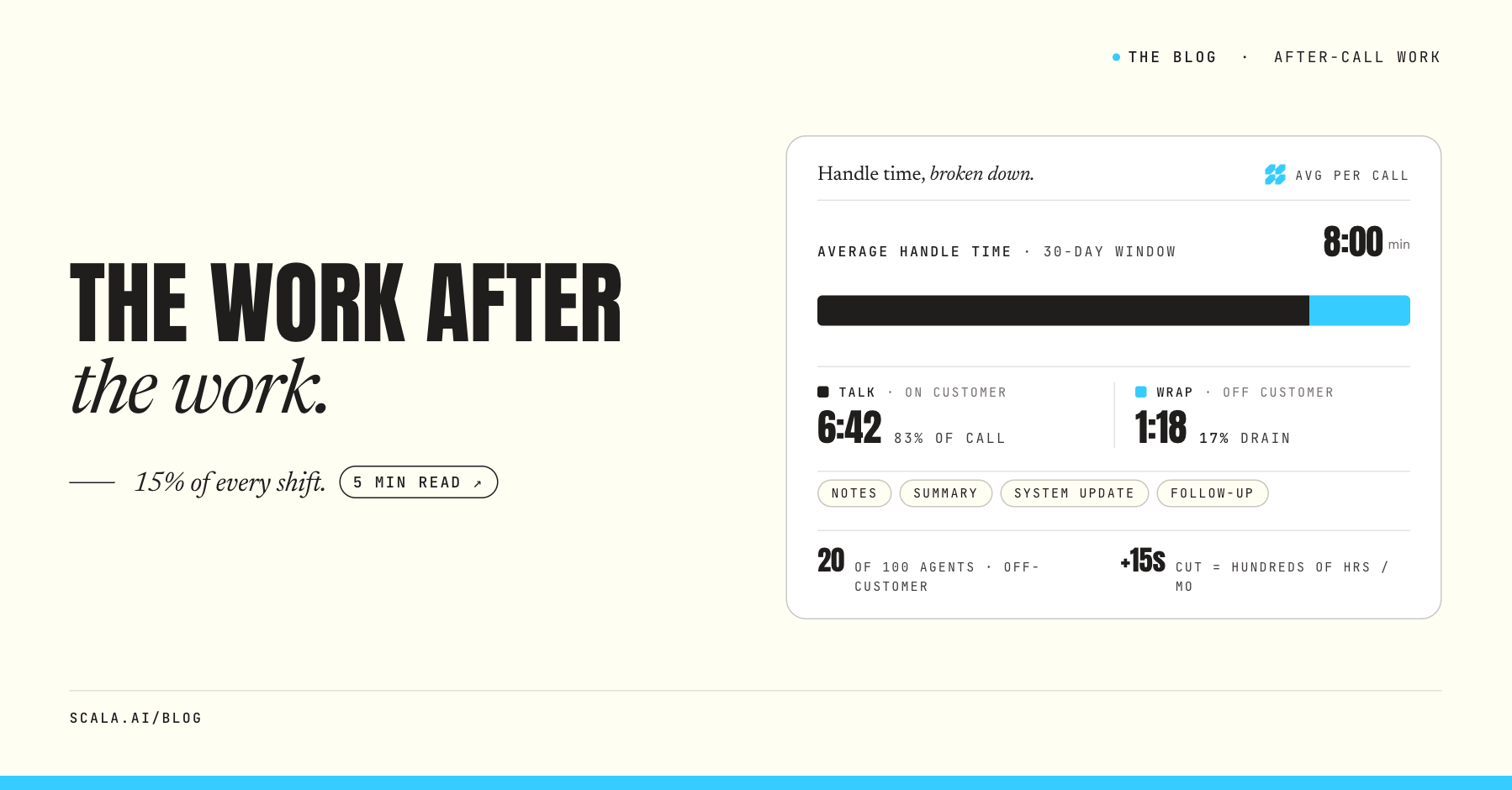
Every contact center measures handle time. Few measure what's inside it.
After the call ends, the work continues. Notes. Summaries. System updates. Follow-up tasks. Required work that requires no judgment from the person doing it. Just their time.
Research puts after-call work at 15 to 20% of total agent time.
That number rarely gets treated as a problem. It gets treated as overhead. Part of the job. Something to manage around rather than remove.
That's the wrong perspective.
Across a team of 100 agents, 15 to 20% of capacity is never reaching a customer. It's being absorbed by documentation that people are doing and automation could handle. At scale, that's not inefficiency. It's a structural drain built into the operating model.
The assumption underneath it: post-call work belongs to the agent.
It doesn't. It belongs to the interaction.
The call already contains everything needed to complete the notes, trigger the update, and close the task. The agent is the manual step between the conversation and the system. Remove that step and the operation changes without adding a single person.
Cutting after-call work by 15 seconds per interaction adds hundreds of hours of capacity each month across a large team. Not from hiring. Not from restructuring. From removing work that was never the agent's job to begin with.
Agents stay focused on customers. Handle time drops. Coaching time opens up. Burnout pressure eases. The operation becomes easier to run without becoming harder to staff.
Scala deploys AI agents that handle post-call work automatically. Notes, summaries, follow-ups, and system updates, completed using the workflows and rules the team already runs on. No engineering required. Agents launched in hours, not weeks.
The work after the work doesn't have to belong to your people.
Learn more with a Scala Demo

.webp)