7 Reasons Scala Is the #1 Enterprise Contact Center Intelligence Platform
.webp)
7 Reasons Scala Is the #1 Enterprise Contact Center Intelligence Platform
Most contact center leaders aren't short on tools. They're short on clarity. They have dashboards, scorecards, QA platforms, coaching software, and workforce management systems, all running in parallel, all telling a slightly different story. The result is a fragmented picture that forces leaders to react to symptoms rather than fix root causes.
That's the problem the market has been trying to solve for years. And it's where most platforms fall short.
Cresta excels at real-time agent coaching in sales-heavy environments. Observe.ai is the go-to for post-call QA. NICE CXone consolidates infrastructure but bolts AI onto a routing-first architecture.
Scala doesn't pick a lane. It's the operational backbone.
The core distinction: Scala is the only platform built from the ground up to unify fragmented contact center data into a single intelligence layer, then close the loop from insight to action, in real time, across every channel, role, and workflow. Not as an overlay. Not as a sampling exercise. As the foundation your entire operation runs on.
Here are the 7 reasons enterprise contact center leaders are choosing Scala over every alternative in the market.
#1: A True Single Source of Truth, Not Another Dashboard
The phrase "single pane of glass" has been abused by every vendor in the contact center space. What most platforms actually deliver is a consolidated view of their own data, while your CRM, workforce management system, ticketing platform, and telephony stack continue to operate in silos.
Scala's Pulse is architecturally different. It connects to the CX systems you already have, ingesting signals across conversations, workflows, performance data, and operational context, and builds a unified intelligence layer on top of all of it. The platform continuously observes every interaction, identifies patterns that traditional tools miss, and surfaces the specific insight needed to act before problems reach customers.
What the competition offers instead
Scala doesn't ask you to rip and replace. It embeds with what you have and makes the whole system smarter. That's the difference between a tool and a backbone.
#2: Closed-Loop Execution, From Insight to Action
Intelligence that stops at a report is just expensive hindsight. The real test of a contact center platform is whether it can translate what it observes into measurable change, automatically, without requiring a six-week implementation project every time an insight surfaces.
Scala is built around closed-loop execution. Pulse doesn't just tell you what happened; it shows you why, and then points to what to do next. That cycle, observe, diagnose, act, measure, runs continuously across the operation.
"When leaders manage with intelligence, execution moves faster, and smarter." Ardie Sameti, Co-Founder & CEO, Scala
Most platforms in the market break this loop somewhere. Post-call analytics tools like Observe.ai are strong on the "observe and diagnose" half but require manual intervention to translate insights into coaching or process changes. Platforms like Cresta close the loop within their own agent assist layer but don't extend that closed loop across the broader operational picture.
Scala's closed-loop advantage covers:
- Early warnings surfaced before customers ever experience the problem
- Root cause identification, not just symptom reporting
- Automated performance intelligence that connects quality signals directly to coaching and training
- Execution tracked to measurable outcomes, not just activity
#3: Performance Intelligence That Covers the Full Hybrid Workforce
Contact centers in 2026 don't run on human agents alone. AI agents handle an increasing share of interactions, and the measurement challenge has grown to match. Most QA programs were designed for a world where every interaction was human-to-human, and they haven't caught up.
Scala's Performance Intelligence module was built for the hybrid reality. It measures performance across every interaction, every channel, every role, and every language, with AI-driven evaluation replacing the sampling-based QA approach that leaves the majority of interactions unscored.
The sampling problem in traditional QA
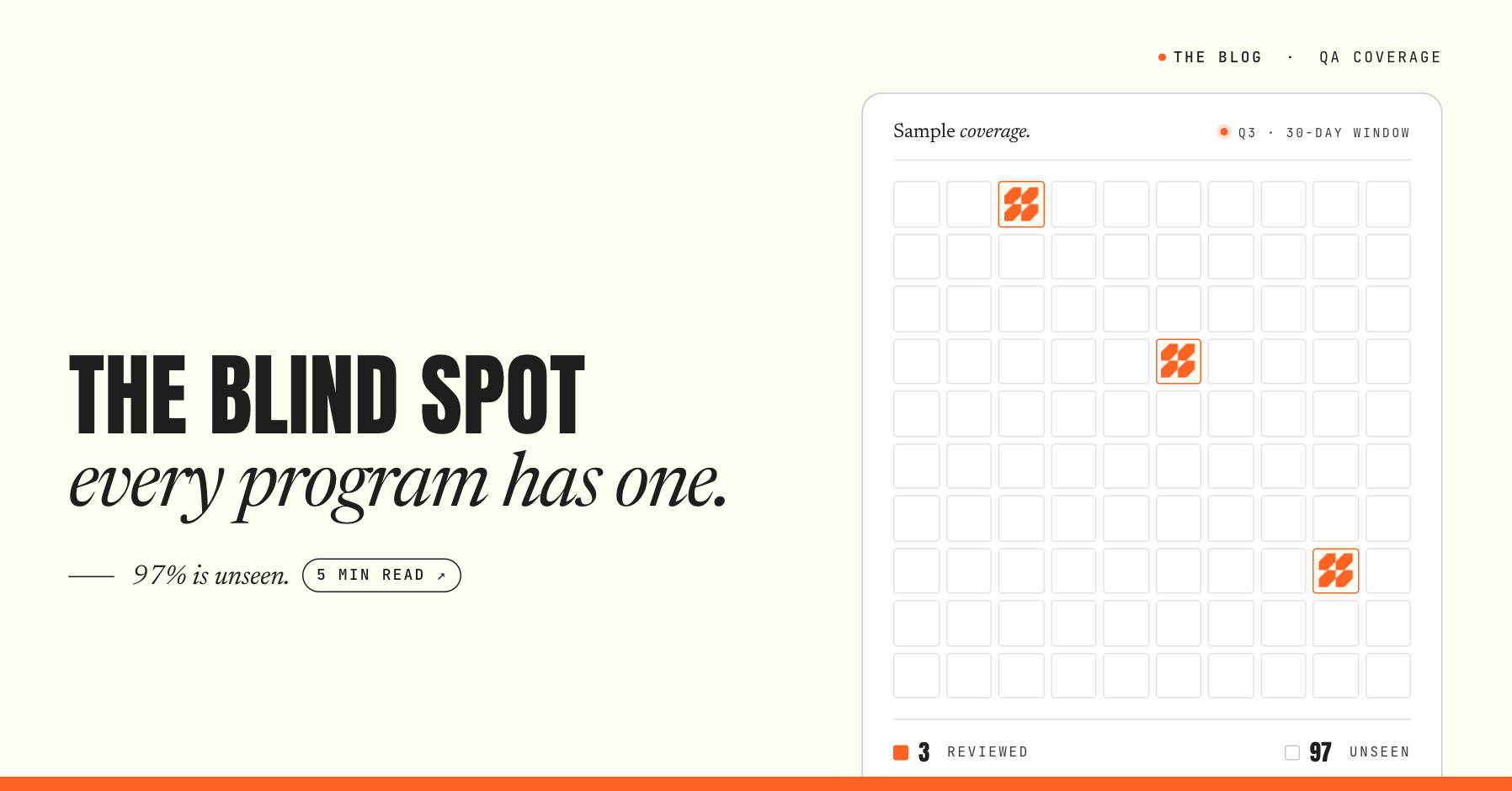
The industry standard for manual QA review hovers between 1% and 5% of total interactions. That means for a contact center handling 100,000 calls per month, leaders are making coaching, training, and process decisions based on a maximum of 5,000 data points, and often far fewer. The other 95,000+ interactions are invisible.
Scala replaces that sampling exercise with continuous, automated evaluation. Every interaction gets scored. Every signal feeds back into coaching and training decisions. The QA program stops being a compliance checkbox and starts functioning as a complete operational signal.
What this means in practice:
- Consistent scoring standards applied across human agents and AI agents simultaneously
- Coaching recommendations that connect directly to observed performance gaps
- Quality signals that update in real time, not on a monthly review cycle
- Full language coverage, removing the blind spots that multilingual operations typically face
#4: AI Agent Deployment Without an Engineering Dependency
The promise of AI automation in the contact center has consistently run into the same obstacle: getting from concept to production requires engineering resources that most operations teams don't control. Vendors like ASAPP offer powerful generative AI capabilities, but the implementation timeline and custom AI requirements put them out of reach for teams that need to move fast.
Scala's Agent Canvas eliminates that dependency entirely.
Operations leaders can design, launch, and manage AI agents across customer-facing and internal workflows without writing a line of code. Every agent is trained on the organization's specific business logic, brand language, and operational rules. The result isn't a generic chatbot; it's an AI agent that behaves exactly as the team would, for the cases that actually matter.
From concept to production in hours, not months
The competitive landscape on deployment speed is stark. Enterprise-grade platforms with deep customization typically require 4 to 16 weeks of deployment time. Scala's no-code Agent Canvas compresses that timeline dramatically, with the guardrails and compliance controls that enterprise operations require built in from the start.
Agent Canvas key capabilities:
- Design customer-facing and internal AI agents through a visual interface
- Train agents on proprietary business rules, not generic models
- Deploy with enterprise compliance controls and governance guardrails in place
- Manage and iterate on agents without returning to engineering for every change
#5: Strategic Execution Support, Not Just Operational Reporting
Most contact center platforms stop at the operational layer. They tell you what's happening on the floor, but they leave leaders to figure out the strategic implications on their own. The gap between operational data and executive decision-making is where a significant amount of time and resources get lost.
Scala's Pulse Assist is built to close that gap. It functions as an intelligent AI partner trained on the organization's systems, data, and operational context, enabling leaders to pressure-test decisions before committing, diagnose performance gaps at depth, and execute initiatives with the precision of a highly experienced operator.
This capability has no direct equivalent in the competitive landscape. Cresta's coaching intelligence is agent-facing. Observe.ai's analytics are operations-facing. Neither platform is designed to serve as a strategic decision-support layer for senior leaders.
What Pulse Assist enables
- Performance gap diagnosis: Identify the root cause of operational issues, not just the surface-level symptoms
- Decision simulation: Model the impact of proposed changes before rolling them out across the operation
- Board-level reporting: Draft executive materials directly from operational intelligence, without manual data aggregation
- Cost reduction initiatives: Identify and execute efficiency opportunities with clear accountability and tracking
The practical impact: Leaders spend less time compiling reports and more time making decisions. The platform does the synthesis; the leader does the strategy.
#6: Enterprise-Grade Security Built In, Not Bolted On
Healthcare and travel contact centers operate in some of the most compliance-sensitive environments in any industry. A platform that handles patient data, booking records, and personally identifiable information at scale cannot treat security as an afterthought.
Scala's security architecture is built on a defense-in-depth model, with compliance certifications that match the requirements of the most demanding enterprise environments.
Compliance certifications
SOC 2 Type 2 - Continuous third-party audits of security controls
HIPAA - Full compliance for healthcare contact center data
CCPA - California consumer privacy protections
GDPR - European data protection standards
Beyond certifications, every AI agent interaction is governed by policy-driven integration controls with full decision trails. Bias monitoring, strict data boundaries, and explainable AI outputs are built into the platform architecture, not optional add-ons.
The competitive field here is mixed. Some platforms carry HIPAA and PCI compliance as baseline requirements. Others treat compliance as a sales conversation rather than a technical reality. Scala's position is straightforward: the organizations it serves require uncompromising standards, so the platform is continuously audited to match them.
The bottom line for regulated industries: Security isn't a feature on a checklist. It's the reason a healthcare system or airline can trust AI to operate inside their customer operations without creating regulatory exposure.
#7: Measurable Results in Weeks, Not Quarters
Enterprise software has a reputation for long implementation timelines, slow value realization, and a gap between what was promised in the sales process and what gets delivered in production. It's a reputation the contact center intelligence space has done little to shake.
Scala is built to deliver measurable results fast, because the organizations it serves cannot afford to wait quarters for ROI.
The platform embeds with existing CX systems rather than replacing them, which eliminates the infrastructure overhaul that makes full-stack CCaaS deployments so time-consuming. Pulse connects to what's already in place. Agent Canvas enables operations teams to build and deploy AI agents without engineering involvement. Performance Intelligence begins scoring interactions immediately.
Why speed to value matters more than feature breadth
A platform with 50 features that takes 12 months to implement delivers less value than a platform with focused, high-impact capabilities that are operational in weeks. The contact center market has learned this lesson repeatedly: complexity without speed is just expensive potential.
What world-class operators are choosing Scala for:
- One clear view of the whole operation, from day one
- Early warnings before problems escalate to customers
- Root cause insights that replace surface-level reporting
- Closed-loop execution from insight to action
- Measurable results on a timeline that matches the pace of the business
The vendors that require 8 to 16 weeks just to get infrastructure stood up are selling a different product to a different buyer. Scala is built for operators who need to move.
The Bottom Line
The contact center intelligence market in 2026 has no shortage of capable platforms. Cresta is strong in real-time agent coaching. Observe.ai is a proven QA engine. NICE CXone consolidates infrastructure at scale. ASAPP handles large-scale automation with precision.
But none of them do what Scala does: unify the entire operation into a single intelligence layer, close the loop from insight to action, cover the full hybrid workforce, and deliver measurable results without requiring a rip-and-replace infrastructure project.
The category has been waiting for a platform that treats intelligence as the architecture, not an add-on. That platform is Scala.
If your contact center is still reacting to symptoms instead of fixing root causes, the problem isn't your team. It's the tools they're working with.
See what Scala can do for your operation. Book a demo at scala.ai/demo.